
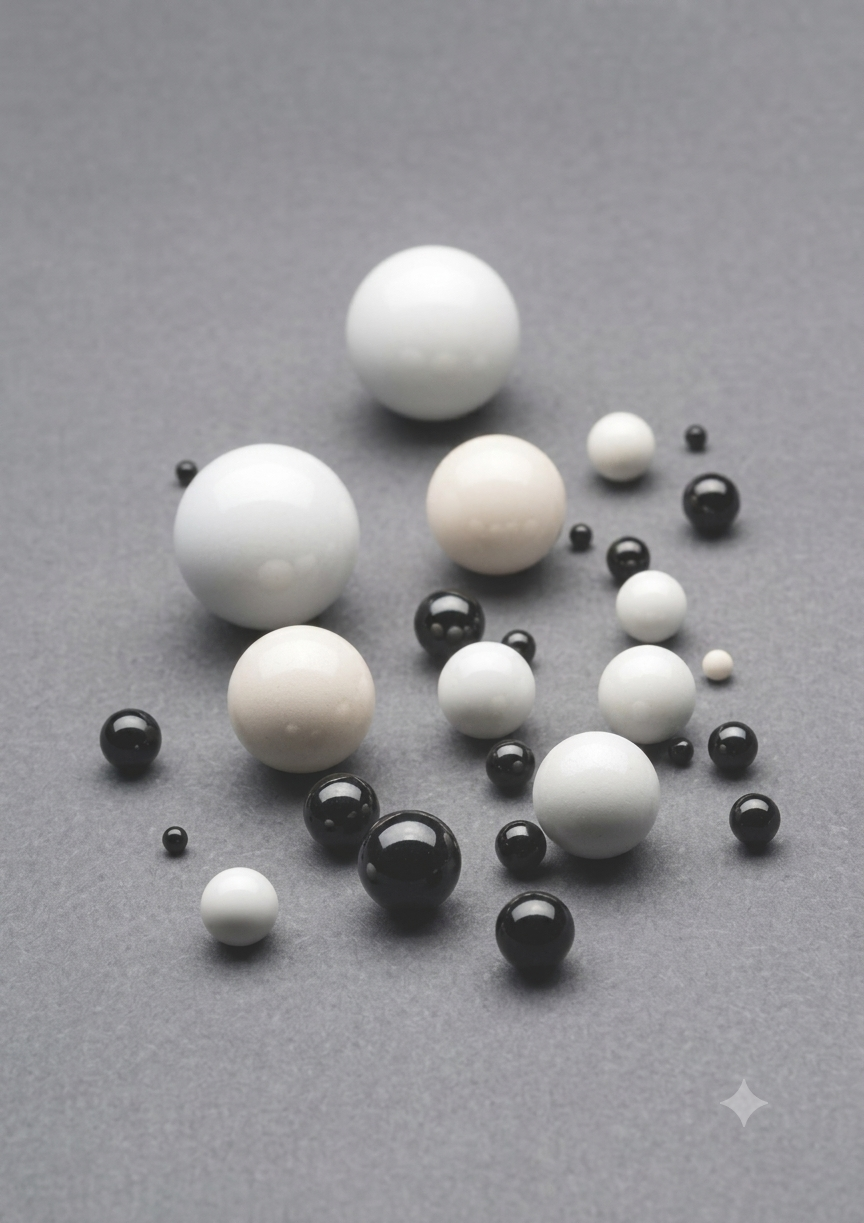
Ceramic Balls
Ceramic balls are particularly suited to harsh environments. Their main advantages over steel is that they have a density of 40% lower than steel. Have 29% lower thermal expansion and are 150% harder. In certain high-speed applications their life is extended by as much as a hundred times. The three main materials used are Alumina Oxide, Zirconia Oxide and Silicon Nitride.
5
Variants
ISO
9001:2015
Technical Data
Si₃N₄ — Silicon Nitride
The most widely used type of ceramic due to very high resistance to wear and abrasion in general. It does not require lubrication, is resistant to corrosion, is anti-magnetic and electrically insulating, and continues to be efficient at high temperatures up to 1400 °C. It combines extreme hardness with high precision. Si₃N₄ balls are widely used in high precision bearings in the aerospace industry, in machine tools, measurement instruments, mechanical centrifuges, radar and missiles, pumps and compressors.
Al₂O₃ 99.50% — Alumina (Alumina Oxide)
This material has a multi-crystal structure and excellent resistance to abrasion and high temperatures. It is resistant to most corrosive agents, but is not recommended for use in contact with hydrochloric and hydrofluoric acid or strong alkaline solutions. Al₂O₃ balls are used in valves, pumps, and ball bearings.
ZrO₂ — Zirconium Oxide
The material has a high degree of compactness and considerable flexural strength, which makes it very reliable. It also has a low modulus of elasticity, close to that of steel, together with an extraordinarily low thermal conductivity.
Al₂O₃ 99.99% — Ruby
A non-porous single crystal structure used where particular hardness and extreme resistance to wear are required, together with low specific weight and chemical inertness. The material consists of pure aluminium oxide with a small percentage of chromium oxide, which gives it its characteristic red colour — the most visible feature of these balls in measurement and control instruments, valves, and pumps.
Al₂O₃ 99.99% — Sapphire
This material has a single crystal structure and, unlike ruby, is transparent. Because of its optical properties and high refractive index, balls made of this material are used as chemically inert lenses.
Ceramic Balls — Properties of Materials
| Physical Properties | Sapphire and Ruby | Alumina Oxide | Silicon Nitride | Zirconium Oxide |
|---|---|---|---|---|
| Structure | Single crystal | Multi-crystal | Multi-crystal | Multi-crystal |
| Chemical Formula | Al₂O₃ | Al₂O₃ | Si₃N₄ | ZrO₂ |
| Purity % | 99.99 | 99.8 | 95 | 97 |
| Density g/cm3 | 3.99 | 3.9 | 3.2 | 5.5 |
| Operating Temperature (°C) | — | 1800 | 1100 | 1000 |
| Melting Point (°C) | 2050 | 2050 | 1900 | — |
| Softening Point (°C) | 1800 | 1725 | 1400 | — |
| Specific Heat at 25 °C (CAL/g/°C) | 0.18 | 0.25 | 0.17 | 9 |
| Thermal Conductivity | 36 W/m°K | 29 W/m°K | 29 W/m°K | W/m°K |
| Mechanical Properties | ||||
| Vickers HV10 Hardness (N/mm²) | 17000 | 16500 | 24000 | 20000 |
| Modulus of Elasticity (N/mm²) | 4.3×10⁵ | 3.5×10⁵ | 3.1×10⁵ | 2×10⁵ |
| Breaking Modulus at 25 °C (N/mm²) | 392 | 470 | 700 | 600 |
| Compressive Strength at 25 °C (N/mm²) | 2060 | 2354 | 2500 | 2100 |
Chemical Resistance
Sapphire / Ruby:
Inert to most acids at very high temperatures.
Alumina (Oxide):
Inert to most acids, but not recommended in environments with hydrochloric or hydrofluoric acids or strong alkaline solutions.
Silicon Nitride:
Inert to most acids.
Zirconium Oxide:
Inert except to hydrofluoric acid and strong concentrations of sulphuric acid.
Figures shown are typical published values for these ceramic grades — please confirm exact figures against your supplier's certified data sheet before publishing.
Resources & Technical Documents
Dimensional Conversion Chart
Inch ↔ metric size cross-reference table
Technical Data
Material specifications, tolerances & grades